Showing posts with label perspective. Show all posts

Jun 5, 2019

Bloom Season

Spring is here. Where I live, spring is basically summer, but still. It is the season for blooms. In the several pots on my deck and patio, flowers are blooming. Some have just begun to show their colors after the cold (all right, cool) weather, and others are fading now that the heat is kicking in. One planter in particular is preparing to showcase a blaze of color within the next few days: in it are a gerbera daisy and a geranium side-by-side, their blooms to be deep orange and hot pink. These plants came through the winter, to my surprise, and I am excited to see their little buds and the small beginnings of petals.

Enter my daughters, nearly-four and one. They have a wading pool on the deck. They have a hose with gushing water. They have buckets. Do they want to play with these things? No. They want to pick flowers. 

At first, I ask them not to. What a reasonable request, right? The few blooms on the geranium are gone within about three trips of my one-year-old from the plant to the pool, where she is dropping the flowers one at a time into the water. They look pretty when they float. My last hope is the buds on the geranium that haven't started to open yet (they aren't showing any pink, so maybe my daughters won't see them). The single bloom on the gerbera daisy, I know, is doomed.

The gerbera daisy has a blooming pattern that I have found requires patience. It produces about one to three flowers at a time, and each bud takes what seems a painstakingly long amount of time to open completely. Once the blooms open, they remain for a while, making them worth the wait, but when they fall, there is a long period of waiting again before the next round of blooms appears.

On my daisy plant now is a single bloom that has barely begun its work: tiny petals extend from the center, pale orange and narrow, like squat embroidery needles. I know that in a few days' time, the petals will stretch, unfold, and deepen to their full orange color. I am looking forward to seeing the flower. But my children do not understand this expectation.

I try to explain it to my older girl. Maybe she can understand, but she doesn't seem very interested. She's more interested in the here-and-now (I can't blame her; she's only almost four). She is learning to be patient, but she would rather pluck the flower now, early, to play with it, than wait for it to bloom fully. 

In my frustration at the loss of most of my blooms and potential blooms, I have a choice: I can get upset, yell, and sweep the girls up and take them inside, ending play time with the fury of my dragon-mom fiery wrath (dragon-mom is a real thing), or I can patiently let the children be children. They are exploring. They want to enjoy examining the flowers, picking each petal off and feeling it in their fingers. They want to see how the petals look in the water. They want to play with pretty things. Their actions are not malicious. 

As I sit in the lawn chair, trying to enjoy the outside play time as much as my daughters apparently are, I remember words from Paul David Tripp's Parenting, the book I'm reading with my care group right now. He asks, "Do physical things get in the way of, or create needless tension in, your parenting?" I take a deep breath and look at the flowers. They are, indeed, physical things. They are objects, not people. My daughters are much more valuable than the orange and pink blooms. I can relax. This summer, the world will not come to an end, even if every single bloom is plucked early from my plants. And I doubt even my industrious children could manage that feat.

My children are learning patience, and so am I. Tripp writes that "[i]n every moment as you are parenting your children, the heavenly Father is parenting you." I need to hear this truth: I need God as my parent every bit as much as my children need me as a parent (I suppose even more so). God is teaching me to be patient and gracious with my children, and I am a slow learner. He reminds me here on the deck, as my girls pluck flowers, that the true blooms to wait for are not growing in planters. They are running around naked in the backyard; they are little now, but will be grown-up some day (sooner than I imagine), their deepest, brightest colors yet to be seen.

Petals plucked and dropped on the dirt in the pot.


Feb 18, 2019

How to Survive Your Cold (and Enjoy It, Too)

The cold and flu season is in full swing. Where I live, close to the Texas Hill Country, it has also been the season for cedar pollen, leading to what for many is comparable to getting a severe cold or even flu-like symptoms, called around here "cedar fever." The dreaded pollen can cause such terrible allergies that last and last until finally they develop into sinus infections, fevers, sore throats, coughing, congestion that blocks ears: the works.

As I battled with my most recent bout of the cedar fever, a sinus infection, and took care of my two young daughters, who also had fevers and runny noses, I struggled to keep a positive attitude. When everything was sore and two small children were cranky for days (and nights!) on end, who could really blame me? Well, the truth is that it would have helped my family and me to survive the sickness without all the grumpiness if I had simply practiced thankfulness. Wait, thankfulness? For infections? Yes. Thankfulness, even for infections.

According to research, as discussed by Amy Morin in Psychology Today, practicing thankfulness has been shown to improve mental, psychological, emotional, and even physical health. Clearly it is in our best interest to try gratefulness in place of grumbling. However, what about a cold is there to be grateful for?

This is where a bit of discipline and creative thinking come into play. In 1000 Gifts, Ann Voskamp argues that thankfulness is at times a sacrifice. In other words, it's hard to do, but worth the challenge. I've written more in-depth about the sacrifice of thanksgiving elsewhere, and giving thanks through difficult circumstances is on my mind a lot. Though it takes self-control to give thanks instead of gripe, I can think of several ways I could (at least in theory!) give thanks for sickness.

When I'm sick, I try to slow down and let my body rest as much as possible. I can be thankful for the slower schedule, even though it might be forced on me against my will. If I have a chance, I can even take a hot bath (the steam is great for congestion!) and relax a bit, maybe with a drop or two of eucalyptus essential oil to add an invigorating scent that reportedly helps clear congestion. When my kids are napping, I can nap. I can be thankful for yummy, hot soup (maybe my husband will bring me pho!). Trying to find small things to enjoy during a cold is one way to be thankful.

More importantly, perhaps, getting sick reminds me that I am not in control of my own health, ultimately. Yes, I can control the food I eat, my exercise, and - to some extent, being a mom of littles - how much sleep I get. But I cannot stop myself from getting a cold, no matter how many elderberry gummies I chew per day. God takes the opportunity when I get sick to remind me that I am frail. Yet despite the frailty and relative lack of importance of my life (considering by comparison God, the maker of the universe), He still cares for me intimately. My motherhood matters. My personal dreams and goals matter. My health matters to Him, who showed compassion for the sick when He walked the earth (and still does today). When I'm sick, it is easier to see both how small I am and also how my simple, small life matters to God. After all, the little things stand out more to me when I'm sick: the taste of soup, the feeling of a hot bath, the smell of eucalyptus, even being able to breathe! All of these little things are gifts from a God who created my body and said it was good.

So, I can try to be thankful, though it's not easy, when sickness strikes. And when it's through, I can be thankful again that I have a healthy body. Sick or healthy, life itself is such a gift!


Jun 30, 2018

Limitation as Relief from Anxiety

Many of God's attributes pertain only to Him and not to us humans, according to theologians. For example, only God is eternal, self-sufficient, omnipotent, and sovereign. In a book titled None Like Him: 10 Ways God Is Different from Us (and Why That's a Good Thing), Jen Wilkin describes ten of these attributes and why we as limited creatures can draw comfort, hope, and reassurance from the fact that they are true only of God.

Reading this book is showing me something my husband has been trying to tell me for almost as long as he's known me (sorry, honey!): my anxiety stems from my trying to control what I cannot control, know what I cannot know, and be what I cannot be. Essentially, I feel anxious when I reach the boundaries of my humanity and feel responsible for things outside those boundaries.

One night, my toddler was throwing fits at bedtime. At the same time, my infant was screeching loudly in my arms as my husband and I tried to wrangle the toddler into her bedroom for a peaceful routine that would lead to all-night sleep. Meanwhile, my anxiety level was climbing higher. I felt concerned that my baby was learning to scream from my toddler. I recognized as I reflected on the list of attributes pertaining only to God that I felt anxious because I was trying to be omniscient (Is my baby learning screaming from my toddler?) and sovereign (How can I stop this from happening?), when in reality I cannot be either of those things. When I stopped and noticed that I wasn't responsible to know the answer that I could not know or control the situation that I could not control, my shoulders relaxed a bit and some of the tension melted. Of course, some tension remained, as there were still a screeching infant and fit-throwing toddler to be dealt with.

Knowing the limits of my humanity and accepting instead of fighting them allowed me to be calmer and feel more peaceful, even in the midst of a trying moment. Wilkin writes that "[w]e are capable of bearing [God's] image as we were intended only when we embrace our limits." If I can stop trying to be God, I can reflect Him better. For me, as a person who struggles with anxiety, releasing that burden of incorrect responsibility - the burden of controlling and directing things that aren't mine to control and direct - is a huge relief.

As Wilkin succinctly puts it: "Because God owns everything, he is responsible for its care and has the right to do with it what he wishes." This is not to say that we do not have responsibility to care for the people and possessions God places into our little spheres of influence, but the ultimate responsibility rests with Him. The care that we take has boundaries and limitations based on our humanness, and these limitations should free us to love well, without worry.


May 8, 2018

Arrows

Heidi St. John's book Becoming Mom Strong discusses the biblical idea that children are "like arrows in the hands of a warrior" (Psalm 127:4). St. John describes her purpose as a parent this way: "Surely we were born for this - to launch our arrows into the world for the Kingdom of God!" In other words, our children do not stay with us forever; they depart at some point or other, and our job is to prepare them to depart well and at the right time, with true aim.

The other day, my toddler (R) woke up early (even for her), at about 5:30. My husband had just that same week started a new job with a new schedule, which allows him to be home in the mornings instead of gone before the rest of us wake up. Our theory on R's wake-up time was that partly she was just excited to see her daddy and was ready to start the day. Of course, along with the early rising came the early beginning of a long day full of "why" questions and stubborn two-year-old willfulness. My perspective was already keyed to be positive (thanks to the Ann Voskamp Joy Dare, which had a prompt for that day to look for gifts found in difficult people); otherwise, I would have absolutely lost it. Instead I only partially lost it.

In any case, I reflected on R's personality that day and how the challenges she presents now may be shaped with her future usefulness as an "arrow" in mind. She loves her daddy, which indicates to me that she has the capacity to develop close and healthy relationships as she matures. She is full of curiosity and the desire to learn, and I'm hoping this desire will stay with her so that she dives into whatever work God has for her with just as much enthusiasm when she's 30 as she does now. Her willfulness now may serve her well in the future by helping her stand firm in her convictions when she faces trials at work, in relationships, and from the general culture (which I suppose will be even more difficult to walk through as a Christian when she is an adult than it is now).

So let me pray that these (sometimes challenging) qualities will develop into beneficial traits as R grows, and that her dad and I will have the wisdom to help her hone her gifts and her personality now, in preparation for the aiming and launching season to come.

Walking with her until she's ready to launch.

Mar 24, 2018

Who's in Charge Here?

I would like to have the authority in my own life to say to my child, "Do not be sick with hand, foot, and mouth disease," or, "get rid of that jaundice right now, young lady." However, the power to control whether or not my children are ill does not fall to me.

The first week home with baby number two (S), my first daughter (R) contracted hand, foot, and mouth disease. We were afraid it was strep throat at first, but when my husband took her to the doctor we found out (to our relief) that it was this scary-sounding but relatively non-threatening disease that caused her to have bothersome red spots all over her hands, feet, face, and hip areas. She was not contagious to adults, and there was little risk that infant S would be in contact with R, which was why we were so relieved. However, there was still a lot of work and trouble associated with the situation. R had fever for a couple of days, she didn't feel well, and we had to prevent her from cuddling her new baby sister. Meanwhile, baby S also had some issues related to jaundice concern. Her pediatrician asked us to get her tested and re-tested for bilirubin levels every day for the first week of her life, which meant trips back to the hospital every day for a week after having finally been discharged after spending two nights there following her birth (two instead of one because I was group B strep positive).

All in all, the first week home with our new baby was not the experience I had desired. I'd imagined lots of rest and cuddles, not lots of car trips with an infant, insanely messy breastfeeding in public, a whining, tired toddler, and little opportunity for much-needed naps for myself.

That week, my Bible study teacher shared her memory verse with me: Matthew 21:23b says, "By what authority are You doing these things, and who gave You this authority?" The Pharisees were challenging Jesus with these words. Of course, the questions are provocative; since I believe Jesus has ultimate authority, given that He is God, I have no right to question Him in such a way. Meditating on this verse was the very thing I needed that week. As I prayed for help to deal with the tiredness and the two needy children, sobbing, I submitted the time to God. He is the authority of my life, not me.

Remembering Who is in charge gave me comfort that week, but remembering that my life was not all bad helped, too. Around that same time, I was reading the section of the Martin Luther biography by Eric Metaxas that describes Luther traveling many miles on foot to a meeting that could easily have resulted in his own execution by burning. Luther was (understandably) so anxious he had severe stomach pains and was unable to continue walking at one point. By comparison to this extreme hardship, my life was peachy! A little perspective can work wonders. Also, there were some enjoyable things about the week: I got to have lunch out with my husband after a couple of the trips to the hospital, toddler-free (since my mom was watching R for us), and all of those car-rides and dealings with the "outside world" probably helped me get back to a feeling of reality and normalcy after the strangeness of the two-night hospital stay.

In the end, God is good and He knows what He is doing. "Trust in Him at all times, O people; Pour out your heart before Him; God is a refuge for us," says David in Psalm 62:8. Truly God wants to hear from us no matter what emotions we are feeling (including anger or panic), but He also wants us to submit ourselves to His authority and rest in the fact that our peace is ultimately in Him, not in circumstances going exactly how we want.

Dec 9, 2017

Good Silence

It's the most wonderful time of the year, and one of the busiest. Of course, there are the holidays, which line up together in close succession so it seems impossible to grasp one before it slips through your hands and the next one is upon you. In my family, there are some additional celebrations that cause there to be even less breathing room between events: my husband's birthday, my birthday, and our anniversary all fall within a period of time from less than a week before Thanksgiving to less than a week before Christmas. Life can quickly feel hectic instead of joyful at this time of year.

For a week or so I have noticed myself making "to-do" lists in my mind any time there's a moment of silence (when my two-year-old is not asking me "why?"), and even in the midst of conversations. Perhaps this busyness in my brain is the reason a small passage from The Young Unicorns by Madeleine L'Engle resonates with me so strongly. Along with L'Engle's character, I "underst[and] silence, that good silence comes from inside, not outside, and that little, unimportant things can break it more easily than the big ones."

I understand that inner silence, akin to peace, cannot easily be broken by things like "buses and taxi horns and ambulance sirens" (L'Engle), "big" sounds, but I let those insignificant things like worry about the meal plan or whether or not I have time to finish making a Christmas tree skirt or answering my daughter's twelfth "why" of the day barge in and destroy my mind's silence, "break[ing] it up into noise" (L'Engle).

Those insignificant things should not have the power to ruin the silence, the peace and joy, that can run through each day and color it with brilliance. In the end, we'll eat. Decorations come and go. My daughter is a person going through a stage of learning, and I can help her through it. My perspective on our circumstances will affect my approach more than the circumstances themselves, so why shouldn't my perspective be one of contented peace? Paul says, "And we know that God causes all things to work together for good to those who love God, to those who are called according to His purpose" (Romans 8:28). Meditating on such a promise, founded in the truth of a good and sovereign God, my mind and heart can be at peace, resting in good silence, this season.


Sep 26, 2017

Homemade Mistakes

The other day I was able to finish sewing my toddler a new dress. I've made a dress using the same pattern before, so the process was not completely new to me, but I'm still no expert seamstress. While I was able to sew comfortably without making as many mistakes as the first attempt (during which I had to rip out many seams and start over many times, as well as contact customer service for the pattern I bought to ask a question about how to do one of the steps), I still could not execute the project as cleanly as I would have liked.

When sewing the slightly puffed sleeves onto the dress bodice (one of the most finicky parts of the dress, along with the dreaded placket), I could not get through without puckering parts of the bodice on the front of the dress. I had to cut out one part and start over, but then the same thing happened again anyway, and then again with the second sleeve. Frustrated, I held up the dress to my face to examine my error and sighed. Should I cut the threads and start again, probably with the same result?

pucker one

pucker two

before hemming
In a moment, I decided to leave the mistakes as they were and abandon my impulse to make the dress look "perfect." The dress is homemade, after all, I told myself. It has more character with a bit of mess-up in it. And who's going to notice these small puckers once the entire dress is complete and my goofy, friendly, sweet daughter is inside it?

Homemade life, by which I mean real life (not magazine or Instagram or Facebook life) has flaws. As much as I want to be in control, organized, and on top of things at all times, I'm human. This lesson seems to return to me over and over: I will make mistakes, it's fine to make mistakes, and mistakes can even be good as they teach me important things. Making mistakes shows me and the people around me that I'm a person just like everyone else; mistakes invite openness and trust. Can people be comfortable with someone whose life is essentially a Real Simple photograph?

Furthermore, as my mom always told me (and as experience has shown to be true), people aren't looking that closely at me; they are too busy worrying about themselves! If someone is getting close enough to see a tiny pucker in my life, I am probably returning the favor and we are having a constructive chat about our problems. If that person is secretly judging me in private, then it's not my problem at all.

However, if someone does look at my life, flaws and all, I hope the sweetness of the heart of Jesus can overpower any impression of my personal faults. I'm not perfect, nor can I be in this lifetime, but Jesus told His disciples to "be perfect, therefore, as your heavenly Father is perfect" (Matthew 5:48). The perfection of God's intentions, desires, mindset, and plans should be visible through my own motives, mindset, and actions, even though I mess up. The puckers and ripped seams are mine; the finished beautiful garment, which will in the end be perfected (Romans 8:22-30), is God's.

Aug 25, 2017

The Former Student

Recognition swept across both of their faces as Callie stepped out of the elevator at the floor of her office and almost walked into the person standing there. Both simultaneously said, "Hey, how are you?" Then the older woman waiting to get on the elevator asked, "Did you teach this summer?"

"No, I didn't; it was a nice break," Callie answered with nods of emphasis.

"I know - I came to see you, but you weren't there - I figured you weren't teaching. Hey, what did you think of my 'Goodman Brown' paper?" Jane, confident, without fishing for a compliment, asked in her pleasantly loud voice.

"I thought it was good, really insightful, in-depth," Callie answered truthfully, though caught off-guard by the question, and having had a solid three months of break, having moved to a new city, and having planned for a new semester all since reading that final research paper.

"Oh, thank you! I just knew it was good. Thank you, Ms. Trindle!" Jane poured out the words with genuine delight, though her countenance displayed a sense of self-assurance and a knowledge that she was fine with our without this bit of affirmation. "Your class was my favorite class of all time, so far in my school," she added.

"Well, good; I'm glad you enjoyed it," Callie said, still taken a little aback.

"You're an awesome teacher," Jane continued, but with an air of ending the brief encounter so both ladies could move on with their schedules.

Callie, laughing, not sure how to respond, but wanting to do so graciously, said, "Thanks - you were an awesome student!" She really meant it, too, although that language, borrowed from Jane's remark, would not have been her own choice, she being such a deliberate and subdued teacher. Relating to students on a personal level had always both excited and puzzled her: how casual could she be? Could she let her guard down, or didn't she have to maintain that invisible boundary, for authority's sake? She was so young, after all, for a college teacher (in her mind, anyway): twenty-six, and just recently married, with no kids to add any of that almost intangible "mom-gravity" to her person, that gravitas that some teachers seemed to have, maybe since they were used to taking no nonsense from their own little 'students' at home. Callie did not reflect on all of these thoughts often, but her general picture of herself was definitely tinged with the drab colors of small, pervasive doubts and cautions.

The carpet and walls looked sharper as she walked back to her office after this conversation with her former student. Half-closed blinds and some buildings outside obstructed the view through the window at the end of the hallway, so that as she walked towards it, Callie could only see a small patch of what happened to be a bright blue sky.

Jun 24, 2017

Peppermint Lemons

Once when I was a kid my cousins from about eight hours away came to visit during the summer. My aunt, who happens to be one of the neatest ladies I know, gave us a special snack one afternoon while we took a break from swimming in the pool in the backyard. She cut holes into unpeeled lemons and stuck soft, fat peppermint sticks (the kind that dissolve easily) into the holes. The candy sticks acted like straws after we started to suck on them, because the acidic lemon juice worked its way inside and made holes through the candy. Those simple lemons became especially refreshing sweet and sour treats through the creative addition of sugary mediators.

My two-year-old daughter came down with a nasty stomach bug this week and was vomiting for a night and a day. She could hardly keep down even simple liquids. Ice chips saved the day that first day of sickness, keeping her hydrated, at least. The second day, she stopped throwing up and was able to keep down some liquids and food, though she was still zombie-like (definitely not her usual, energetic self). The third day, she finally showed signs of returning to normal levels of talking and activity, a huge relief.

Though the first couple of days of her sickness were trying and we lost a lot of sleep on the first night, I rather enjoyed the lazy and cuddly quality the days took on. My daughter and I spent a lot of time situated comfortably on the couch (which I now need to clean), either listening to music or watching a baby animals show, and dozing on and off throughout the day. We both benefited from the catch-up on sleep and rest, and I greatly enjoyed the way my daughter relaxed with her head in my lap or stretched out flat while I rubbed her back. Touch is one of my strongest love languages, and usually she doesn't sit still long enough for me to even brush out her hair.

Uncomfortable, sour-tasting events make us wince, like sucking on a plain lemon. But if we can find something sweet in the midst of the situation, our perspective can change. The hard thing may not go away, and we will still have to deal with it, and dealing with it may not at all be easy. But the flavor of the day can be transformed, even though we still have to eat the sour part of it.

Sweetness in the middle of sickness.

Rest when we needed it.

Cuddles make everything better.

Apr 28, 2017

Alternate Packing List

Everyday Basics:
  • smiles
  • laughter
  • kindness
  • patience
  • songs
Must-Haves:
  • prayer
  • verses tucked away in hidden pockets
Don't Forget:
  • flexibility
  • deep breaths
  • lots of hugs
In Case of Emergency:
  • spare big-girl panties

Feb 11, 2017

He Loves Me Even When He's at Work

In honor of National Marriage Week, I want to write about one of the lessons I've been learning in my own marriage lately (which is just an easier way of saying I struggle to handle this situation like an adult sometimes).

Due to the nature of my husband's job, he has some seasons of busyness that can leave me feeling lonely and even unloved. My strongest love languages*, the ways I most clearly receive and naturally want to give love, are touch and quality time. Needless to say, when my husband works long hours, I do not get touches from or quality time with him. As a stay-at-home mom, I instead spend most of the day (and night!) caring for a little one and feeling, at the end of each week, pretty well emotionally drained.

At those times when I'm feeling most lonely and in need of some simple affection from my guy, my awful tendency is to start resenting him and his job instead of remembering the plain truth that it is a blessing that I have such a loving husband in the first place and that he has a job that allows him to take care of our needs in the second place.

I should also remind myself during those times that my husband's love language is not the same as mine. In fact, his love language is most often acts of service. When he's at home, he loves me by taking care of the house and doing chores I may not have had time for that day. He also perceives his job as an act of service (and therefore love) for me. When he's working hard at his job, he's actively loving me. He hasn't forgotten me.

Let me also never forget that ultimately the meeting of all of my emotional needs comes from my Father in heaven, not from my husband (though I believe God uses my husband in many ways to meet those needs). God showed His great love for me by sending His Son, Jesus, to die for me even though I was not loving Him back (Romans 5:8). He loves me still even when I do get resentful of my husband's work and both totally disrespect my husband and sneer at God's precious gifts in doing so. He is always with me. He has promised never to leave or forsake me (Hebrews 13:5).

Let me speak truth to my tired and lonely heart even when I don't feel it this week: I am loved, and I am not alone.

___

*The idea of love languages comes from Gary Chapman's The 5 Love Languages.

Jun 1, 2016

All or [Something]

My daughter's first birthday is approaching, and I've been remembering the day she was born. The labor and delivery experience was mostly just what I could have hoped for, but there were a couple of incidents that I wish I could go back and change (as you can read about in a post I wrote to document the experience). These lingering regrets were the topic of a recent tearful bedtime conversation between my husband and me. It may seem silly, but yes, that frustrating disappointment was still bothering me. I told my husband that I wished I could go back and fix it. True to his teacherly style (though he's not a teacher), my husband counseled me using a metaphor I could relate to as an English major: "Why? The paper has been turned in. It's done. Forget about it and move on!"

"But I want to turn in an addendum!" I moaned. "I want to fix the broken things." His response was a revelation and turning point for me: "It's not broken." Simple.

He was completely right, of course. Why, then, had I been feeling so strongly that my labor and delivery experience was broken somehow?

My general take on life, especially tasks I feel responsible for, could fit the expression that "it's all or nothing." Washing with a bar of soap that turned out to smell strange? Use it all up anyway. Using cloth diapers? Better not reach for that disposable. Cleaning house? Darned if it's not a disaster every evening when I haven't swept, mopped, dusted, and wiped down the entire house. In other words, it's all or nothing or I've failed.

But lately I've had to adjust my expectations of myself. Having a kid complicates things. Honestly, having a life complicates things. The cloth diapering is a good example of a responsibility that I've relaxed about. Sometimes a disposable is necessary or just plain easier, and using one doesn't mean that all of the cloth diapering is wasted. We can still have the benefits of cloth even if I use a disposable now and then.

The same is true of the labor and delivery that I've struggled to get past emotionally. Nothing about it needed fixing. Rather, my feelings are what need some adjustment. In reality, the experience was a good one. God gave us a healthy baby. My focus has to shift as I think more gratefully than regretfully about the whole thing. Sometimes life is not "all or nothing." Sometimes plain, ordinary "something" is enough.


Apr 27, 2016

Beauty Not Chosen

Recently I listened to All the Light We Cannot See, a novel by Anthony Doerr. One of its predominating themes is that life is fuller when we take in as much of the beauty that surrounds us as we can. Beauty can be found in even surprising packages, like snails, which fascinate one of the main characters in the novel. Listening to the story inspired me to be more aware of my own surroundings and to find them beautiful. Additionally, an old friend wrote to me in a message about the beauty of spring that is starting to emerge in nature and how we might see that beauty reflected in our lives. Consequently, I started to notice and to appreciate the pretty sights in our own backyard.

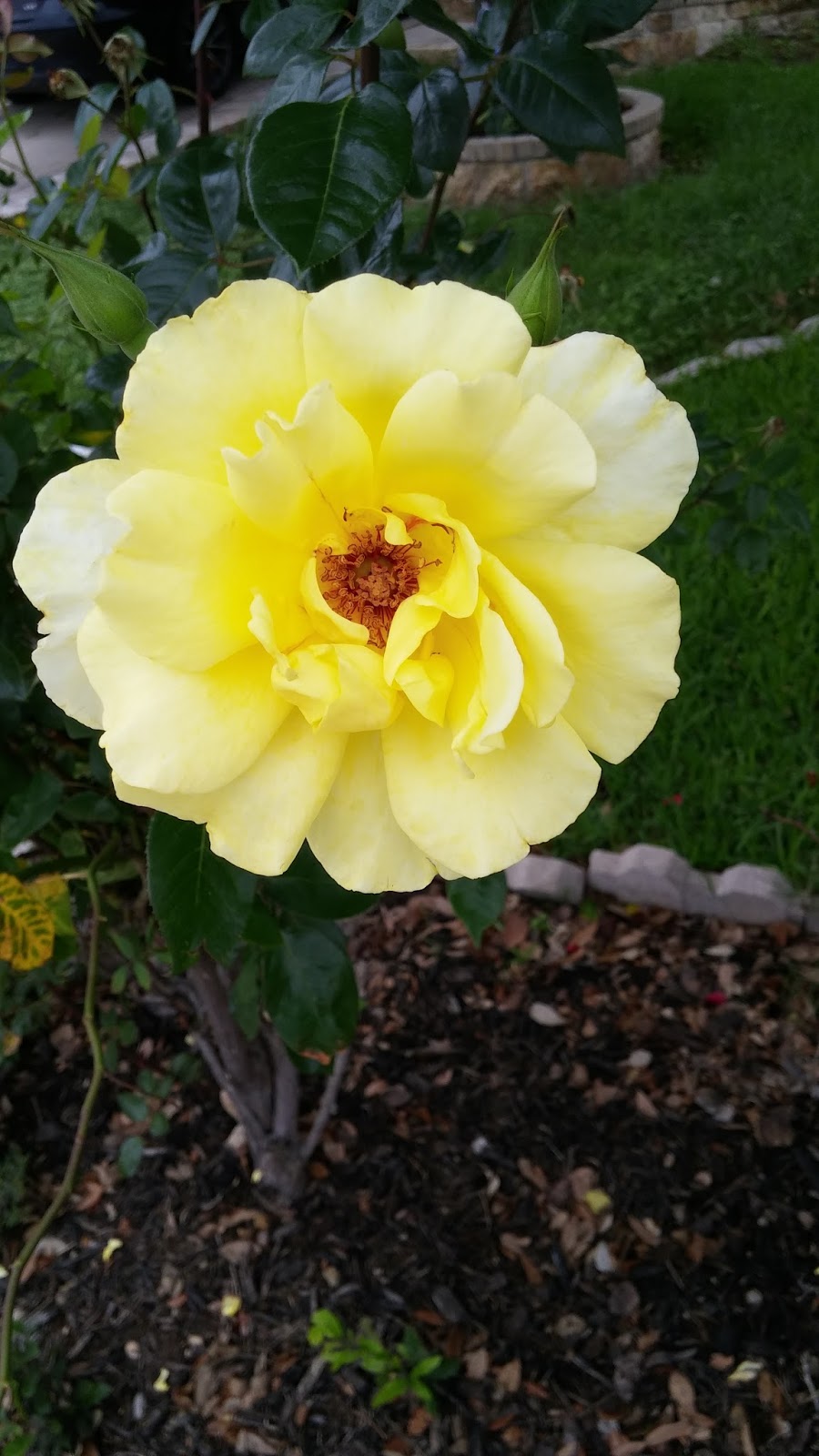
The yard is not one we created ourselves; we moved to this house in the middle of January and inherited the landscaping that was already present, including a few nice trees, and, most notably, rose bushes. The roses were everywhere. They edged the perimeter of the backyard and side yard and they resided in several front yard beds as well. Everywhere we turned we saw roses. They weren't exactly nice to look at, either. They were scrubby, gray, branchy, thorny things. There was no way to tell if they were even alive.

My immediate response to so many roses was less than positive. Roses would certainly not be my first, second, third, fourth, or even fifth choice in terms of landscaping. (Read: I would never choose them.) Roses are notorious for being difficult plants riddled with pests and plagued with diseases, as far as I know. Plus, they are overrated. And thorny.

Then some blooms appeared. They appeased me a bit. I looked up some information on how to take care of roses, started pruning, and decided that maybe they would be worth the work.

Now as May approaches, the roses are getting ready to kick it into high gear. More and more blooms have adorned their thorny stems. I'm appreciating their presence. After all, if they weren't there, we'd have a bare yard.

Although the roses are not what I would have chosen, I'm beginning to see and value their beauty. In much the same way, I recognize there are aspects of my life I wouldn't have chosen right now, but if I take the time to learn about them and make an effort to cultivate them, I can also value their beauty. Having a baby has been a challenge, and I would not choose to be waking up to settle a little ten month-old multiple times a night in my ideal world, but I can take from this situation many beautiful blooms: extra cuddles, the chance to provide for my daughter, the opportunity to lean heavily on my Father's arms.

Sometimes at night I hum to myself the hymn about "leaning on Jesus, leaning on Jesus, leaning on the everlasting arms." His love is sustaining me and His burden is light. This truth is sweet and beautiful to me as a rose.


Feb 23, 2016

Try and Fail

I recently listened to Anne of Green Gables by L. M. Montgomery. When I heard Anne make the claim that "next to trying and winning, the best thing is trying and failing," I nearly fell out of my socks. I'm notorious for wanting to know with absolute certainty, one hundred percent of the time, with no exceptions, exactly what the outcomes will be in any given situation. If, somehow, I don't foresee said outcomes, or if, like sensing an impending storm, I sniff out dangerous outcomes ahead, I would sooner not attempt the task, not step into the situation, not make the decision, not go, not join in, not try. The idea that it's better to try and fail than not to try at all is simply shocking to me.

Yet I believe the idea might just be true. I don't mean in contexts involving a decision resembling gambling. Wisdom should be involved. But given the application of wisdom, what harm is there in failure? Embarrassment? Shame? Hurt? Vulnerability? Pride doesn't want me to feel these things. But what if feeling a bit embarrassed is what it takes to at least gain a new experience or learn more about life (even if it just means learning I'm not great at something)? I know learning is good, and pride isn't a valid reason to do or not do something.

Ah, yes, but my perfect world in its perfect orderly state is in jeopardy if I try with the possibility of failing. On the other hand, if I keep everything under control then nothing unexpected happens, and I can dance through my day without the slightest hint of a misstep.

Well, news flash, self: you are never really in control in the first place!

It may feel like I'm conducting the orchestra, but the Lord, the sovereign Creator, is the one who actually maintains even my ability to breathe. If I recognize this truth, maybe I can relax enough to try when there's a possibility of failing.

But why bother? What is there to gain? I think perhaps the gain is itself partly a loss: loss of fear, anxiety, and pride. The gain is also trust that's placed in God more than in myself. Maybe the gain could also be having a bit of fun. Wait, no. That can't be right.

Jan 25, 2016

List 25: Things I'd Rather Be Doing Right Now


  1. Knitting the hat I started the other day
  2. Baking
  3. Going for a walk
  4. Talking with a friend over coffee
  5. Sleeping
This is an interesting list for me because I have been learning lately that I need to relax and enjoy the tasks that have been assigned to me. I may not have as much freedom in my schedule as I had before the baby, but I can still find enjoyment in the little things that seem to dominate my day. Who says it's my day, anyway?

Aug 28, 2015

What's the Best?

Once upon a time I was a young student worried about my performance on an upcoming test or project. My mom told me, "you know we don't expect you to be perfect; just do your best." "But, Mom!" I responded, "What if my best is a 100?"

Yes, I am a perfectionist. Recalling this story made me reflect on how I've been feeling lately as I relate to my new daughter. I'm trying to take care of her in the best ways, which often makes me anxious that I may not be measuring up. I worry about making mistakes. But yesterday as I thought about my own mom and how much little girls learn from their mothers, I realized what a disaster it would be if I got everything right, and what a mess we'd be in if I never messed up.

My daughter will gain tremendously from my imperfections. She will see someone make mistakes but not give up trying. She will see a woman who is loved by her husband despite not being the ideal wife. She will experience living with someone who isn't afraid to welcome friends over even though she doesn't have the house in order. She will learn that grace is not earned. She will learn that God works in our lives when we are weak, and that we don't have to work harder to make Him pleased with us.

I hope my mistakes will help my daughter learn that she is valuable not because of how well she performs, but just because she is preciously made in God's image. I hope she sees relationships as being more important than trivial tasks. I hope she knows for herself the beautiful truth that God chooses to love unconditionally. He accomplishes His purposes through us despite our imperfections, and this brings Him glory!


Jul 30, 2015

Scarcity

It was around two in the morning and I was awake, feeding my little daughter. My husband had recently discovered information about "natural breastfeeding" (which had led to a huge improvement in the feeding endeavor!), so I was practically lying down, my length spread out on the couch in the living room so I wouldn't disturb my husband. I was reading My Antonia by Willa Cather, a book I'd wanted to read for a long time. (It seems having a baby suddenly gives one more time to do certain things, while drastically reducing time to do others!) I came across a passage that almost startled me with its implications for my own thinking, especially in this season of quick changes:
Trees were so rare in that country, and they had to make such a hard fight to grow, that we used to feel anxious about them, and visit them as if they were persons. It must have been the scarcity of detail in that tawny landscape that made detail so precious.
That week my husband had returned to work after having taken time off for paternity leave, and I had been feeling down about the loss of those special weeks with him at home. There were many enjoyable activities that had characterized that time: reading good books aloud during feedings, taking the baby with us to go grocery shopping, eating meals together. I had been frustrated that many of those activities had come to an end upon my husband's return to work, but then reading this passage about trees helped me gain a better perspective.

I realized that some of those activities had been unique to that time when the three of us were at home, and had been, therefore, made even more special. It was not only my husband's return to work that had caused certain tasks or events to be unique to a time, either. Just the fact that our child is growing rapidly means that many enjoyable things, such as cuddling a sleepy newborn baby, will be unique or will last only a short amount of time, whether that time be a minute or recurring throughout a couple of weeks. My waking at two a.m. to feed our daughter will not be a permanent fixture of my life, nor will catching her cooing and smiling in only the way that a young baby does before learning to laugh and smile on purpose. The very scarcity of these things is, partly, what makes them precious.

The new type of schedule imposed on me by my little girl is one that involves frequent changes. Rather than having long periods of waking and sleeping, we have shorter times of waking, sleeping, eating, and, yes, pooping. Even writing this post is taking me several days with spaced-apart bouts of thinking and typing. This baby-induced schedule of small increments is another reminder that there can be value in scarcity or brevity. The idea is blossoming for me that I can enjoy being present in and appreciating the current moment, rather than trying to maintain a steady mind-hold on the entire day, week, or even (crazy as it may seem) lifetime. Alas, this is a lesson God has been teaching me throughout my life: I am not in control, and all I really have is the current moment in which to enjoy His gifts and trust Him completely.